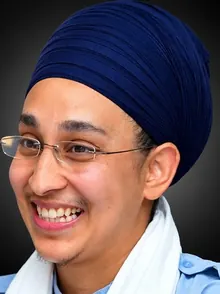
When the bus moved, a few people from his year could see him on the other side of the crossing. Bishan Singh was late for school that morning, which is the only reason he was wearing a Dastaar (Sikh turban) there at all.
“When the bus moved they saw me on the other side and they started laughing,” he says, “and I was like, oh gosh, this is not going to go well.”
He was already anxious, and he knew it “was going to be a bit weird for everybody”. His plan was to “firm it for one day”.
He was 17. He says he is from “quite a middle class and white background” and grew up in Nottingham, with parents who consider themselves agnostic. In Year 12 he read the Quran, the King James Bible, the Bhagavad Gita and other Hindu and Buddhist texts. Then he began on Guru Granth Sahib Ji, in an English translation he found as a PDF online.
In time he told his parents he did not really want to cut his hair again.
Someone at the Gurdwara (Sikh place of worship) gave him the cloth for a Dastaar, and he began practising that day from YouTube videos, a few hours every day. “I was thinking in my head, like, I don’t know if I can do this, I’ve not got any hair,” he says. “Do I need hair to do this?”
He wore it in the house and took it off to go out. Then came the morning, around April or May of Year 12, when there was no time to take it off.
The head of sixth form’s office
He explained himself to nobody until they asked. That day or the next, as he remembers it, he had to go to the office of his head of sixth form.
“He thought I was, like, dressing up,” Bishan Singh says.
So he explained. “I’m making a change,” he recalls telling him. “I’m trying to convert or change my faith.”
Some people at school had already noticed, he says, and had come up to him “in a nice way, respectfully” to say they had heard he was changing his religion. Once the Dastaar was on, it was different. “People get nervous to ask questions,” he says. Their reaction, as he gives it: “Oh, this guy’s pretty serious, let’s leave him alone.”
“At this point I look like a white guy with the Dastaar on,” he says of himself then. “I think now I look a bit more like a Sikh.”
At home his parents were “a bit concerned, which is valid”, and “a bit overwhelmed by the whole thing”.
Nice jeans in Walsall
A few weeks on, by his telling, he decided to go to the first Amrit Sanchar he saw, the ceremony at which Amrit (Sikh initiation) is given. A poster led him to one in Walsall. His dad took him. He had almost no Sangat (spiritual community) of his own yet.
He arrived “proper smart”, in nice jeans, because “you gotta look nice for your Amrit Sanchar”. His hair was still so short that if he took his Dastaar off, he says, “you wouldn’t think I was keeping my Kes” (uncut hair).
The Panj Pyare, who conduct the ceremony, had questions for him, “which is obviously the right thing to do”. He says he had turned up looking like someone doing dress up and then trying to take Amrit. He had come ready to be told to come back later.
He was also asked to speak to a man he calls Babaji, who questioned him through a translator, including about the length of his hair. “He literally said, do you have a Bana?” Bishan Singh recalls. “And I was like, no, and he pointed to his wardrobe.” Bana is traditional Sikh dress. Babaji gave him one of his own, and he changed into it.
“When I was there, and this isn’t just a cliche, I felt like I was transported back to 1699,” he says.
He had never sat or stood for so long in his life. Nobody told him to come back later.
That was Sunday 25 June 2023. The next day he had his first mock exam for his A-levels. He had revised, he says, but his head was somewhere else. He tied “this huge Dumalla”, another style of turban, and went to school.
“I was so anxious about my exam and judgment from other people,” he says.
The exact same life
In the days that followed, the doubt he describes was his own.
People say there is a high after Amrit, he explains, and that the adrenaline lasts for the first few days. He did not want to start “messing up” once it had gone.
Everything about me has changed, but what if, even though everything about me has changed, nothing actually changes and I just end up living the exact same life before but in kind of fancy dress.
The phrase was borrowed. A few minutes earlier in the conversation, one of the hosts had said that Sikhi is not fancy dress, speaking of people who put on a Dastaar for a few days to see where it goes. Bishan Singh had answered that looking the part puts nobody level with the people they admire: “you can’t be on that level without putting in a lot of effort”. Then he turned the phrase on himself.
What he did about it was get up. He built a routine around Amrit vela (the early hours before dawn), rising at “maybe five, half five”. He admits he sometimes missed it. “It happens,” he says.
The other answer came from home. His family, he says, kept telling him that “it doesn’t matter what you look like, it matters what’s actually inside”. He came to agree. Changing, as he puts it, means “other things as well, like being a more compassionate person, being more patient, being more respectful, little things like that”.
In Year 13 he was back with his head of sixth form, “the same person who questioned me about my Dastaar”. This time, he says, the two of them worked together on a policy for the school and its academy trust on the Kirpan, the small sword he now wore as an initiated Sikh.
He is in his second year at the University of Leicester now, and still being asked how a white Sikh happens. “It’s a blessing, isn’t it, to be able to explain to people and maybe inspire somebody,” he says. “But it’s a bit jarring sometimes.”
At the crossing, the plan had been to firm it for one day.
Watch Bishan’s full conversation, from the moment he leaves for school, late, with his Dastaar still on.
This article is drawn from Bishan Singh's conversation on Finding Sikhi. Quotations are Bishan's own words, lightly tidied for reading.