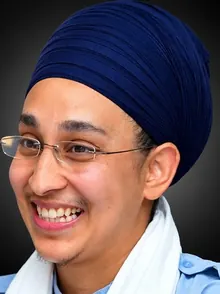
As a child in Belgium, Japjeet Kaur had a couple of surgeries. Each time, the silver bracelet she wore had to be cut through before she went under general anaesthetic. And each time, she says, “there would be a new one waiting for me.”
The bracelet came from her grandfather. He gave it to her parents to put on her from the day she was born, and when she outgrew one he gave her another. She remembers his instructions as clear ones: “It should never leave her body. She needs to keep it on at all times.”
It was plain. “No decoration, just round, just like a Kara but in silver,” she tells the hosts, the Kara being the steel bangle Sikhs wear. She has never come across anyone else who had one. It was not a common thing in Belgium, she says, or for Catholics, and none of the other grandchildren were given one.
Her grandfather had his own name for it. “He called it a slave bracelet,” she says. When one of the hosts asks what it represented, she answers: “It was seen as your handcuff to God. That’s how my grandfather explained it to me.”
That explanation is all she has. He died before she came into Sikhi, and she never got to ask him what she wanted to ask: “Who told you this? Where did this come from?” Her parents never told her anything about it.
She had always had one on her. Then she went to Amritsar.
The only one in her family
Her grandparents on both sides were Catholic. Her parents were “very much not practising”. Even so, until she was six or seven she talked to God, to herself or out loud, and did her rosary at the side of the bed. The rosary was her grandmother’s, passed down to her. She was the only one in her family who did any of this. Her mother said many times that she was going to become a nun, and it was something she considered.
In her early teens, a close member of her family and a close friend of her own age died within a short space of time. She started asking questions about death and, she says, did not get answers that satisfied her. “And that’s where I entirely lost my faith.”
By her postdoctoral years in the literature department at Leuven University she was an atheist. “I didn’t want to have anything to do with religion whatsoever,” she says. When a Kundalini yoga class started in her department during the lunch break, she went along to help with her migraines and her back pain.
In the first class a recording of the Waheguru mantra was put on. In the second, a week later, it was the Mool Mantar. “Hair standing on end on my arms,” she says. She had never seen a Sikh in her life, and she did not know what she was hearing.
She stopped going after six weeks. The words kept going in her head all the same. “I would wake up in the middle of the night and just be reciting Mool Mantar.”
About a month later she went back with questions, and found that the teacher barely knew anything herself. So she booked tickets to India, nearly a year in advance.
Two days and two nights
She is clear about what the trip was for. “I didn’t go to Harmandir Sahib with the idea of, I’m going to become a Sikh,” she says. “I just wanted to understand a bit more and travel and go to India for the first time.”
She travelled with her best friend. They landed in Delhi and took a train. She arrived at Sri Harmandir Sahib in Amritsar on the eve of Guru Nanak Dev Ji’s Gurpurab, the celebration of his birth. She had never been to a Gurdwara (Sikh place of worship) before.
“I walked down the steps and I put my head on the parkarma and I cried for two days and two nights,” she says. The parkarma is the walkway around the pool. “I couldn’t stop crying.”
It was evening, and Rehras Sahib (the evening prayer) was being recited. To describe what it was like she uses the word pani, water.
It felt like someone had given me some pani to drink and I didn’t even know how thirsty I was, how parched I was.
“It’s like my skin didn’t exist anymore and I just melted into something,” she goes on. She also had “a whole lot of questions at the same time”. She calls those days “something I wanted to run away from at the same time as never leave again”.
They stayed for a week.
What the bookseller gave her
When they left the complex, among the crowded shops outside, an old uncle came up to her and started speaking in Punjabi. She understood none of it. His son came over to translate. His father, the son told her, was saying it was written on her forehead that she was a Sikh of Guru Nanak Dev Ji.
“Talk about freaking someone out,” she says.
The old man sold books. He went into his shop and found every English book he could, and she left with a pile of them and a full backpack. “And he also gave me my first Kara,” she says. She knows she paid for the books. Whether the Kara was included in the price, she cannot remember.
“So there in Amritsar Sahib I took off that slave bracelet and put on the Kara,” she says, “but it was strange, because I’d always had one on me.”
One of the hosts remarks that the Kara, too, is referred to as handcuffs.
Her best friend told her in those first days, “You’ve come home.”
“For me it never felt like I’ve chosen Sikhi or I’ve even found Sikhi,” she says. Speaking of the Guru as “they”, she adds: “They just grabbed me by the scruff of my neck. I had no choice in the matter.”
She came home after six weeks and started wearing a Dastaar (Sikh turban). On Vaisakhi 2012 she was blessed with Amrit (Sikh initiation).
She still cannot ask her grandfather who told him about a bracelet that should never leave the body, or why he gave one to her alone. What she has is how it looks to her now, and she stresses that this is hindsight. It is, she says, as if Guru Sahib had already been saying: “I’m going to give you an insignia. You’re already mine, but I’ll come and claim you later on.”
Hear her tell it herself: Watch Japjeet’s full conversation, from the moment she walks down the steps at Sri Harmandir Sahib.
This article is drawn from Japjeet Kaur's conversation on Finding Sikhi. Quotations are Japjeet's own words, lightly tidied for reading.