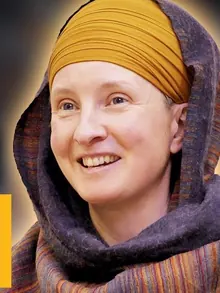
There were slugs in the bath of the house Gurbani Kaur moved into after she married. At one point, she says, there were mice as well.
She had to go downstairs, and her Amrit vela (the early hours before dawn) began with an inspection. “My Amrit vela routine was first to check the coast was clear,” she says. Then she would ask her husband to double check the bathroom.
“I had never lived like that,” she says. What she had known was this: “I used to have a huge bedroom with a balcony overseeing the countryside of Yorkshire, my own en-suite.”
Between that balcony and that bath, her family lost everything, and someone who did not know them paid £15,000 to keep her studying.
Two hours to get ready
Gurbani was born in Leeds, and she describes her younger self plainly: “I was quite spoiled.”
At secondary school, getting ready in the morning took two hours, “one hour to do my makeup and one hour to do my hair, and that was my life”. “All my clothes had to be designer,” she says. “I was into limited edition Louis Vuitton bags and all the fashion trends.”
It made her popular. Everybody knew her, she says, because of the cars her brother drove her to school in. “I remember we had a yellow Lamborghini, we’ve had a Ferrari, Bentley, we have had a lot of cars.” Asked for her favourite, she says she was never really into cars. She liked “the attention that came with it”.
“People would look to us thinking we were the perfect family,” she says. “We had the cars, I went to a really good school, but we weren’t happy at home.”
There was, in her words, “no peace in the home”, and she remembers going to school with “this dreaded feeling” of having to go back.
In her first year at Manchester Metropolitan, after what she calls “difficult experiences”, she arrived at a Gurdwara (Sikh place of worship) and went inside. “I cried for hours,” she says. “I just sat there, people coming in and going out.”
Afterwards she went looking for other Sikh students and joined the Sikh society. Every Saturday they went to the Gurdwara for one hour of Kirtan (the singing of Gurbani, the Guru’s words), followed by Langar (the free community kitchen) and washing the dishes. “Saturday evenings were the best,” she says. “We’d look forward to that all week.”
The students would meet in the city centre first. It was a 40 minute walk from her halls, and she became strict about the timings. She did not want to miss any of the Kirtan, “because it was just one hour in the whole week that we would get”.
She had been to the clubs and the parties as well. Those “were all pleasures but didn’t last very long”, she says. “Whereas the Kirtan, that was something that stayed within you.”
One hour a week became every morning at 7am, before university.
Someone who didn’t know us
She was still new to Sikhi, she says, when “our situation changed and we completely lost everything. We lost our house.”
She says that “when we lost everything, nobody was there, and that’s the reality”.
She did not really know any Sangat (spiritual community) then, she says. The people she told were the Gursikhs (Sikhs devoted to the Guru) she had met when she was blessed with Amrit (Sikh initiation), at the end of her second year. She was studying for her LPC at the time and could not continue, because the funds were not there.
“A Gursikh just paid £15,000,” she says. “Didn’t have any relationship with my family, didn’t know us, didn’t know our background.” He paid her fees, she says, because he had heard of their circumstances and knew she had been blessed with Amrit. Others stood as guarantors and helped with the family’s finances. “They literally put us back on our feet again.”
Her family could not comprehend it. In the life they had come from, she says, everyone was “really attached to money”. These people had children of their own to spend theirs on. “Why did they want to give that to us?”
So when it came to marriage, and her parents were looking at background and wealth, she told her mother she wanted only someone with love for the Guru and for Sikhi. “You could get me married to somebody really rich and we could lose it all, just like we did.” Her parents agreed, and she married at 23.
She had said as much to Maharaj, her name for the Guru. “I said to Maharaj, I don’t want anything else, I don’t need anything else, I just want you,” she says. “So I was tested.”
That was the house with the slugs. There, she remembers saying to Maharaj again and again: “I know I said all I wanted was you, and that still is the same, but just give me strength.”
The school run
By the time the school run was hers to do, she was a mother of two, and her younger son was unwell. She calls that period “a continuous battle”.
When she mentioned it on the school run, another Gursikh who had joined the school messaged her later. They were coming to her house, the message said, to do a Paath (reading or reciting Gurbani).
“We didn’t ask for this,” she says. She was told not to worry about Langar or anything else. All the family had to do was listen with the children.
Towards the end she was “in floods of tears”. “I’ve always been very emotional but I couldn’t at that point control my emotion,” she says. She was “crying out loud but it wasn’t in dukh”, the Punjabi word for pain.
She felt, she says, “like Maharaj had just picked me up”. Around her were “all these Gursikhs praying, taking time out of their busy lives to come and sit with us”.
I felt like the wealthiest person in the world.
It was “just a feeling of being loved and being held”, she says. “We weren’t looking for it, we weren’t asking for it, just came.”
She lived in the house with the slugs for six months, asking for strength. With her son’s health, she says, she has asked for the same thing: “keep our Sikhi strong and give us the strength we need.”
Watch Gurbani’s full conversation, from the moment a Gursikh from the school run says they are coming to her house.
This article is drawn from Gurbani Kaur's conversation on Finding Sikhi. Quotations are Gurbani's own words, lightly tidied for reading.