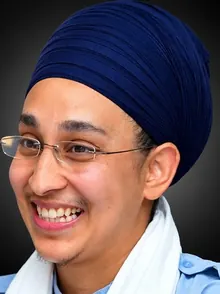
It was about half past nine, which is very early to be in a nightclub. The night had not started yet. Dharmveer Singh had come out with friends and cousins, and he was looking in the mirror.
He had been going to clubs since he was 15 or 16. He was married by now, and by his account the clubbing had dwindled to work nights out. This was the last time.
For the music
Dharmveer was born in Leith, in Edinburgh, the youngest of five brothers. Edinburgh has had one Gurdwara (Sikh place of worship) for a long time, he says, close to home in a building that used to be St Thomas’s church. His parents forced the boys along on Sundays. He sat and listened and “not had a clue what they were talking about”.
A beard arrived when he was 12 or 13. By 15 or 16, short as he was, it was getting him past the bouncers.
“For me it was about the music, though,” he says. “I’ve always been into kind of hip-hop and R&B music growing up.”
He was in a dance group, and once danced in a music video filmed on the hills at Arthur’s Seat. Drink was a small part of those nights: one bottle of a juice-flavoured alcopop to fit in, he says, then water or lemonade. He has never been drunk in his life. His father hated his sons going clubbing all the same, and “used to follow us and phone us all the time”.
Through all of it he kept his Kes (uncut hair) and tied a Dastaar (Sikh turban). His father, he says, was strict about that.
A class on a Wednesday
The change, as he dates it, came when he was 22 or 23, and it started in the street. About a week after a night out, he met one of his cousins. The cousin, whom he does not name, had cut his hair, which made the invitation a surprise.
The Giani at the Gurdwara was running a class on Wednesdays, the cousin said. He recited Rehras Sahib, the Sikh evening prayer, and everyone recited along with him. Dharmveer should come.
“I don’t know what you’re talking about, bro,” Dharmveer told him. “That’s not my scene.”
A week later they met again. “Oh, you never came,” the cousin said. Dharmveer wondered what it was all about, and went.
Six or seven people sat with the Giani. He read from a prayer book and handed round copies in Roman letters, because Dharmveer could not read the Gurmukhi script at all then.
“What got me was the sounds. It was the sounds,” he says. He explains it by the music he grew up on: “I’ve always been into, I suppose, the rhythm, blues, music, R&B. It was the way he was reciting it.”
Rehras had always been on in the house, he says, playing from a tape or a CD in the background. On Wednesdays he was saying the words himself.
When he got home his wife asked where he had been, and he told her. “What’s wrong with you?” she said.
Nothing changed straight away, he says. He kept going to the class. He kept going clubbing too.
Home by ten
Then the mirror. He looked at himself, he says, and took stock. He had his Kes. He had his Dastaar on, tied in what he calls the “samosa style”, and his beard tied up, the way he wore it then.
He remembers thinking that he was a Sikh, and asking himself what he was doing in a place like this. He describes what was around him: the way people were dressed, the smoking, which still went on in clubs then, and the drink.
“This can’t be right,” he said.
He left his friends and cousins and walked out. Home was about half an hour away on foot and he walked all of it, going over what had just happened. “I couldn’t understand it,” he says.
He got in at about ten o’clock. His wife knew the routine, and the routine had him back around midnight. “How come you’re home?” she asked.
“I don’t know. I just couldn’t be bothered with it anymore,” he told her. “Something was telling me just to come home.”
The talk turned to putting a film on and getting a takeaway, and she said that was fine by her. She found the whole thing stranger than he did, he says. He was happy to be home.
That was my last day of clubbing. Never went after that. I decided I’m not going anymore.
What replaced it was a spot on the floor at home. “I started sitting on the floor and doing Rehras in the house,” he says. “Even though I couldn’t read it properly, I was just sitting there.” The family wondered what was wrong with him, then came to respect it, because he kept at it. He added other prayers in “little snippets”.
He ordered Bana (traditional Sikh dress) online from India. The parcel came bound in so much masking tape that he could hardly get into it. He wore the Bana to a programme at the Gurdwara, and his father, he says, asked what he was doing going there with his legs showing.
“Dad, people walk about with kilts on, man,” he replied.
His father was not won over, and his aunts gave him looks. He wore it anyway. “I just felt good,” he says.
Then came Amrit (Sikh initiation). “Amrit is the registration,” he says. “It’s like nursery. You’re just registered into the school.” After a couple of years of practice he asked for it, and was told two or three times that a married man could not take Amrit on his own. He says he could see where they were coming from. Another Sikh he met disagreed and pointed him to a Gurdwara where, after some gentle questions, he was told to come back the next day. He did. That was 2009, and he “never looked back”.
Today, as one of the hosts puts it, he wears Bana full time, at work as well. One of the hosts suggests he must have looked in a mirror every single day, and that it hit him that night because of the classes. Dharmveer’s own advice to anyone praying and still going out, as he was, is to keep the prayer up, “because the change will come and I am witness to that because I was doing both at the same time”.
The conversation goes on to a good deal more, including the heart attack he had at 38. As it winds up, though, the hosts are still coming back to the club and the mirror.
Hear it in his own voice, Scottish accent included. Watch Dharmveer’s full conversation
This article is drawn from Dharmveer Singh's conversation on Finding Sikhi. Quotations are Dharmveer's own words, lightly tidied for reading.